
One Million Tonnes of Waste Converted into Energy in Vinča
One Million Tonnes of Waste Converted into Energy at the Vinča Waste Management Centre
Beo Čista Energija, the City of Belgrade’s private partner in the public-private partnership project for waste management, is pleased to announce that one million tonnes of municipal waste have been used to generate electricity and heat at the Vinča Waste Management Centre.
From August 2021 to August 2026, the Centre received more than three million tonnes of non-hazardous municipal waste. Of this amount, one million tonnes were diverted from landfill disposal and thermally treated at the waste-to-energy facility, generating 455,213 MWh of electricity and 293,172 MWh of heat.
This milestone was achieved while maintaining high environmental protection standards. Emissions from the waste-to-energy facility are monitored 24 hours a day through an automated Continuous Emissions Monitoring System (CEMS). Beo Čista Energija publishes its emissions monitoring results on its website to ensure public access to this information: https://www.bcenergy.rs/rs/emisije/
“The first million tonnes of thermally treated waste represents a fundamental change in the way Belgrade manages its waste – moving from landfill disposal towards using waste as a resource,” said Vladimir Milovanović, Director of Beo Čista Energija. “This is the result of many years of cooperation between the City of Belgrade, our partners and the institutions that have supported this project from the very beginning.”
The facility is a central component of the public-private partnership between the City of Belgrade and Beo Čista Energija, a company established by ITOCHU Corporation (Japan), Veolia (France) and Marguerite, a pan-European infrastructure fund (Luxembourg).
The first million tonnes of waste thermally treated in Vinča represents one of the tangible achievements of this partnership – and a shared success for everyone involved in the project. This milestone reflects the commitment and cooperation of the many stakeholders who have contributed to developing a modern and sustainable waste management system in Belgrade.
Vladimir Milovanović, Director of Beo Čista Energija, will also participate in the conference programme of SEE ENERGY 2026, taking place on 4–5 November 2026 at Čeličana, Distrikt, Novi Sad, Serbia. He will share practical experience and results from the Vinča waste-to-energy project with energy and industry professionals.
More information about the conference: https://events-serbio.rs/en/
LG Electronics at SEE ENERGY 2026: Can Waste Heat Become a New Energy Source for Cities?
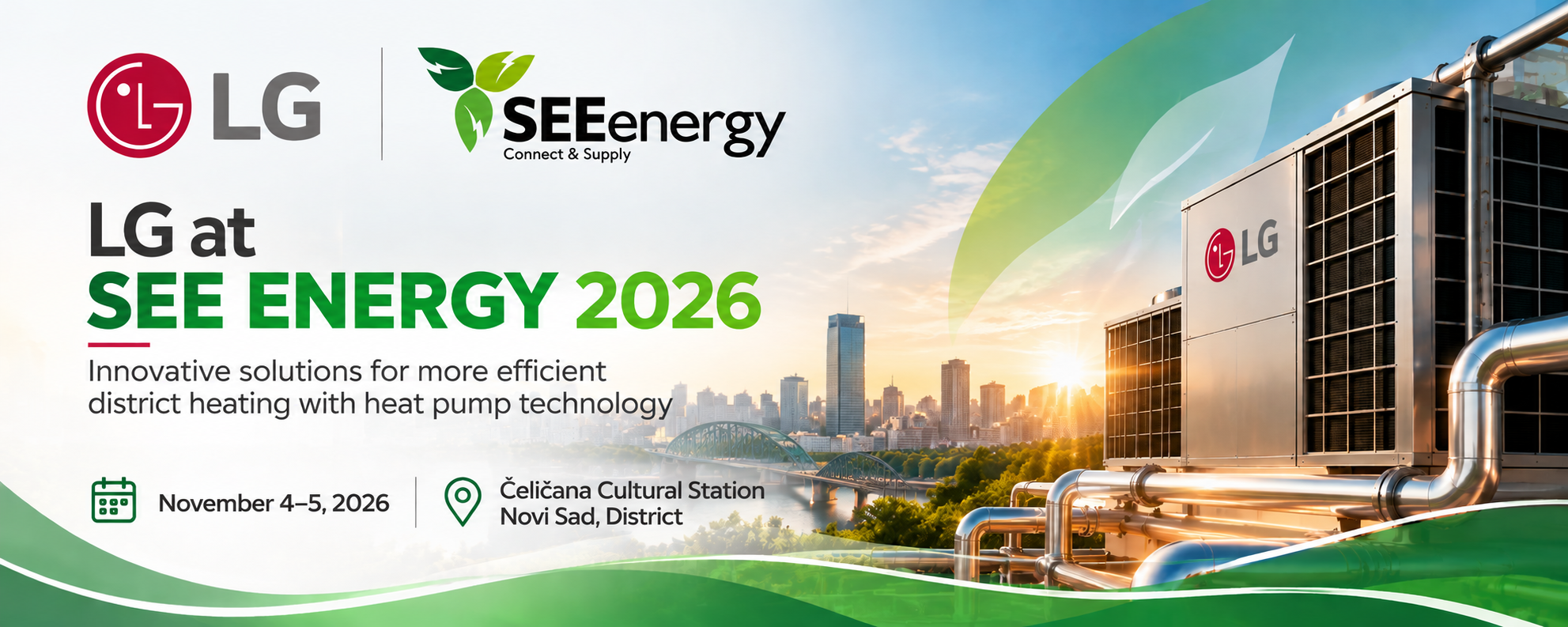
LG Electronics at SEE ENERGY 2026: Can Waste Heat Become a New Energy Source for Cities?
Illustration: LG Electronics at SEE ENERGY 2026 | Visual: SERBIO
Energy released daily into the environment by industrial facilities, data centres and cooling systems could become a valuable resource for heating cities. How can large-scale heat pumps transform this untapped energy into useful heat? What lessons can be learned from European experience, and where could these solutions be implemented in Serbia? These are among the key questions LG Electronics will address at SEE ENERGY 2026, taking place on 4–5 November 2026 at Čeličana Cultural Station in Novi Sad's District.
While much of the discussion surrounding the energy transition focuses on developing new solar and wind power plants, energy storage and reducing CO₂ emissions, one significant energy resource often remains overlooked – heat that is already generated by industry but goes unused.
Industrial production processes, cooling systems, data centres and numerous commercial facilities continuously release thermal energy. In many cases, this heat is discharged into the environment, although, with appropriate technology and infrastructure, it could be recovered and used to heat water, buildings or even entire district heating networks.
This is why large-scale heat pumps and waste heat recovery systems are becoming increasingly important in the development of modern energy infrastructure.
From Industrial Waste Heat to Heating Cities
Unlike conventional systems that generate heat by burning fuels, heat pumps use electricity to extract heat from lower-temperature sources and raise it to a temperature suitable for end users. This means that energy which would otherwise be lost can be reintegrated into the energy system.
Potential heat sources include industrial cooling systems, manufacturing processes, data centres, wastewater and other sources of low-temperature thermal energy.
One particularly promising opportunity is connecting industrial and commercial facilities to district heating networks. Under this model, excess heat from one facility can become an energy source for other consumers.
However, successful implementation depends on several factors, including the temperature and continuous availability of the heat source, its distance from consumers, the requirements of the district heating network, electricity prices and overall project economics.
The question is therefore no longer simply whether waste heat can be recovered, but where its application is technically feasible, economically viable and sustainable in the long term.
LG Electronics: Technologies Connecting Energy Efficiency and Decarbonisation
At SEE ENERGY 2026 – ENERGY FOR INDUSTRY, taking place on 4–5 November 2026 at Čeličana Cultural Station in Novi Sad's District, LG Electronics will present approaches to implementing these technologies, with particular emphasis on their role in modernising district heating systems.
The topic will be presented by Hanbeom Nam (Daniel Nam), Director for Sales Engineering in LGE Central EU countries, LG Electronics.
The discussion will focus on the application of large-scale heat pumps, the integration of different heat sources and technological solutions that can contribute to reducing fossil fuel consumption.
Particular attention will be given to European experience, including examples from Poland, where approaches to modernising district heating infrastructure are being explored and developed.
Such experience is also relevant to markets like Serbia, which have established district heating networks, significant industrial energy consumers and a growing need to improve energy efficiency.
What Does This Mean for Industry and District Heating Operators in Serbia?
The application of large-scale heat pumps raises several important questions for Serbia's energy sector.
For industrial companies, waste heat recovery can offer an opportunity to make better use of energy already paid for through production processes, while reducing overall energy losses.
For district heating operators, integrating new heat sources can contribute to a more diversified energy supply and reduce dependence on a single fuel, provided that the technical characteristics of existing networks allow such integration.
For cities and local authorities, these projects create opportunities to develop energy infrastructure that connects industry, municipal systems and local energy resources.
However, technology is only one part of the solution. Financing, contractual arrangements between heat producers and consumers, year-round availability of heat sources and compatibility with existing infrastructure are equally important.
This is why dialogue between technology providers, industrial consumers, district heating operators, investors and financial institutions is essential to transforming technological potential into concrete projects.
SEE ENERGY 2026: From Technology to Investment Decisions
LG Electronics' participation forms part of the broader programme of SEE ENERGY 2026 – ENERGY FOR INDUSTRY, which places industry at the centre of discussions about the future of energy.
Expert panels will explore solutions for on-site energy generation and management, including gas engines and cogeneration, large-scale heat pumps, smart energy management, solar power plants, battery energy storage systems, waste valorisation and financing energy investments.
The central question of the conference is: How can industry secure more affordable, reliable and cleaner energy over the next three to five years – and how can the necessary investments be financed?
In addition to the conference programme, SEE ENERGY 2026 will feature an exhibition of energy technologies and organised B2B meetings, designed to connect companies with specific energy needs to technology suppliers, engineering companies, investors and financial partners.
The seventh edition of the international SEE ENERGY 2026 conference will take place on 4–5 November 2026 at Čeličana Cultural Station in Novi Sad's District, organised by the National Biomass Association SERBIO.
More information, programme and registration: https://events-serbio.rs/




Latest news
- From Waste to Energy: Elixir Group Presents the Eco Energy Waste-to-Energy Plant in Prahovo at SEE ENERGY 2026
- H-Bridges at SEE ENERGY 2026: Young Engineers Showcase Energy Innovations
- One Million Tonnes of Waste Converted into Energy in Vinča
- Sungrow at SEE ENERGY 2026: How Battery Storage and Solar Energy Are Transforming the Future of Industry
- LG Electronics at SEE ENERGY 2026: Can Waste Heat Become a New Energy Source for Cities?
- SEE ENERGY 2026 at Čeličana: Energy Conference in Novi Sad
- INNIO Jenbacher at SEE ENERGY 2026: Energy for Industry
- H2 Conference 2026: Green Hydrogen as a Roadmap for Energy Transition
- Innovative Biomass Heating Solutions for a Sustainable Energy Future - HARGASSNER Serbia
- Resalta – Driving the Energy Transition Toward Renewable Heat in Industry and District Heating
Contact
National Biomass Association SERBIO
Vladike Ćirića 2, 21 000, Novi Sad, Serbia
Phone: +381 62 179 0383
e-mail: This email address is being protected from spambots. You need JavaScript enabled to view it.

BioRES Project - Sustainable Regional Supply Chains for Woody Bioenergy has received funding from the European Union's Horizon 2020 research innovation programmer under grand agreement No 645994
The establishment of the National Biomass Association SERBIO was supported by:
